The last couple of months have been rather busy, so I wanted to gather a few recent projects and events in one place.
Some of these were presentations of my own art, some were collaborations, and some involved doing the behind-the-scenes technical work needed to help other people’s ambitious ideas happen in public. Across all of it, I’ve been moving between air quality data, immersive visuals, spatial sound, mixed reality, sensors, public events, big screens, coffee, and so many Raspberry Pi installations.
That mix of client work, creative technology, collaboration and experimentation is pretty normal for me, but this particular stretch has brought a lot of the more public-facing work together in quick succession.
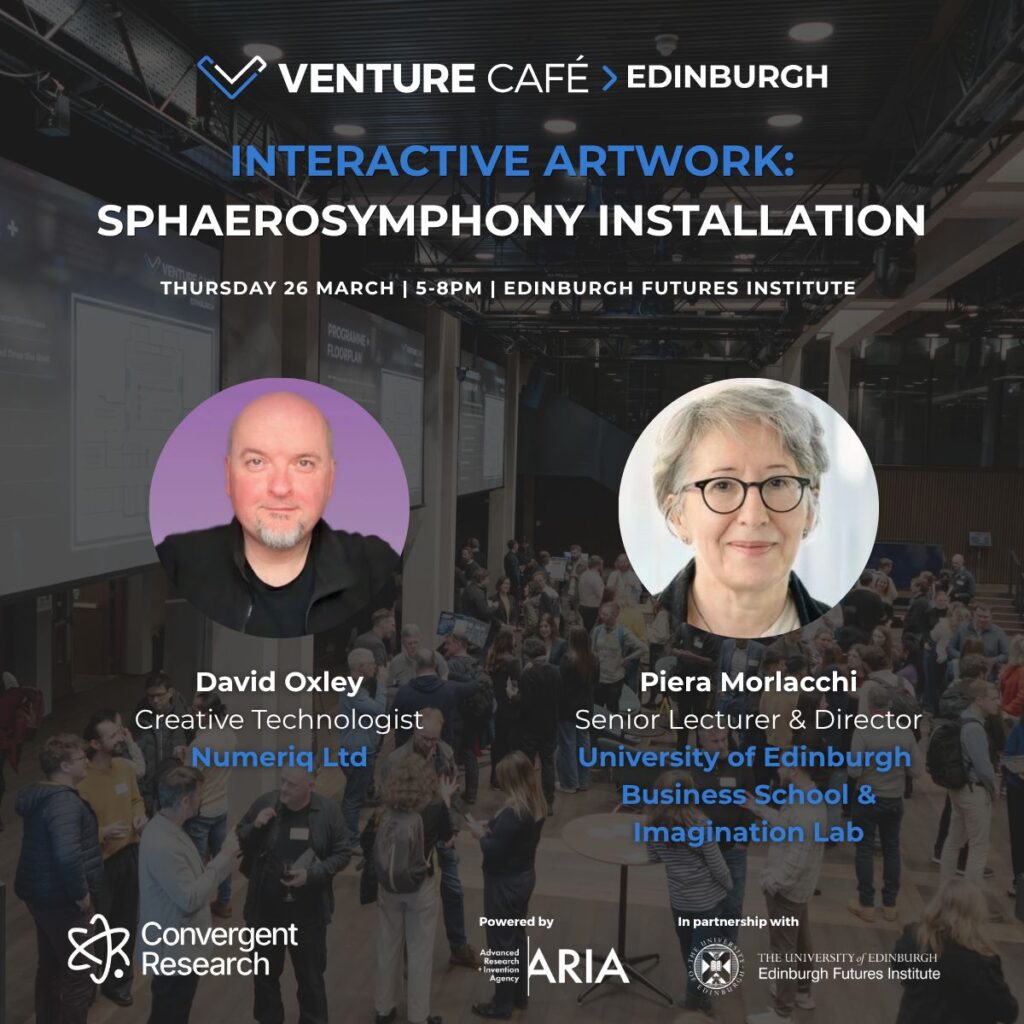
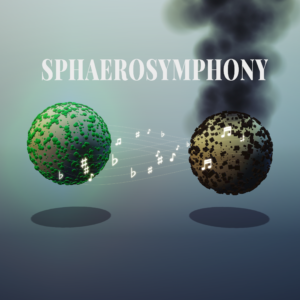
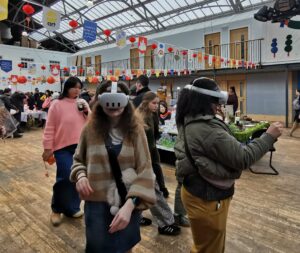
Sphaerosymphony is an interactive artwork created with Piera Morlacchi that transforms air quality data into evolving music and visuals. Visitors could explore the piece through VR headsets and interactive tablets, experiencing how particulate matter readings shape the sound and visual world of the artwork.
This was not a main-stage presentation, but more of an installation or stall within the wider event. That actually worked well. People could come over, try it, ask questions, and spend time with the piece in a more informal way.
It received plenty of attention, and it was also where Alison Daniels spoke to me about Pint of Science, which led to me being invited to speak at the Air: GeoSounds event in May
One of the things I’ve been thinking about with Sphaerosymphony is how to keep the relationship between the data and the artwork clear. It is an artistic experience rather than a scientific instrument, but I still want people to understand that the music and visuals are shaped by real measurements.
Data-driven art can sometimes abstract the data so far that the connection disappears. With this project, I’m interested in keeping that thread visible.
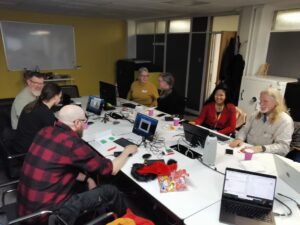
The workshop was not specifically about Sphaerosymphony, but it brought together artists, researchers and practitioners for conversations around imagination, technology, nature and creative practice. It was an intense and interesting couple of days, with discussions that touched on many of the same areas my work often circles around.
The following evening, Piera and I presented Sphaerosymphony: The Music of the Air at the Edinburgh Science Festival.
That event sold out, which was a lovely surprise. We gave a short talk, demonstrated the work, and then had a lively discussion with the audience. There were questions about air quality, data, sonification, public engagement, and how the project might develop further.
The Science Festival was a good setting for the work because people were interested not only in the artistic experience, but also in what it might help communicate. Sphaerosymphony is not a conventional visualisation, and it is not simply a piece of music. It uses music and visuals as a way into thinking about the air around us.
Mixed-reality drones at SI-FAN
Another thread from this period came through Donaldo Tho’s Creative Soundlab event and newsletter.
Stewart Emm from the Edinburgh Cine & Video Society had read about my work with data-driven art, theatre and Raspberry Pi computers, and invited me along to meet them and look at how I might get involved in one of their upcoming events.
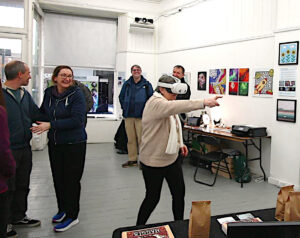
As visitors arrived at the venue, a network of sensors, lights, video and projection systems woke up and responded to their presence. The setup used several Raspberry Pi based systems to trigger lighting, sound and video effects around the space.
The mixed-reality game itself placed drones into the room. Visitors had to rise up against them and destroy every drone before their shields were depleted. If they failed to fight back in time, it was game over.
It was built with Three.js and the Immersive Web SDK, with spatial audio giving the drones, shots and incoming fire a stronger physical presence in the room. I also exaggerated the doppler shift effects as bullets and drones flew towards and past the player, because sometimes subtlety is overrated.
This was a very different kind of project from Sphaerosymphony, but it used a lot of familiar ingredients: real-time 3D, spatial sound, browser-based immersive technology, physical space, and a fair amount of making things behave under live event conditions.
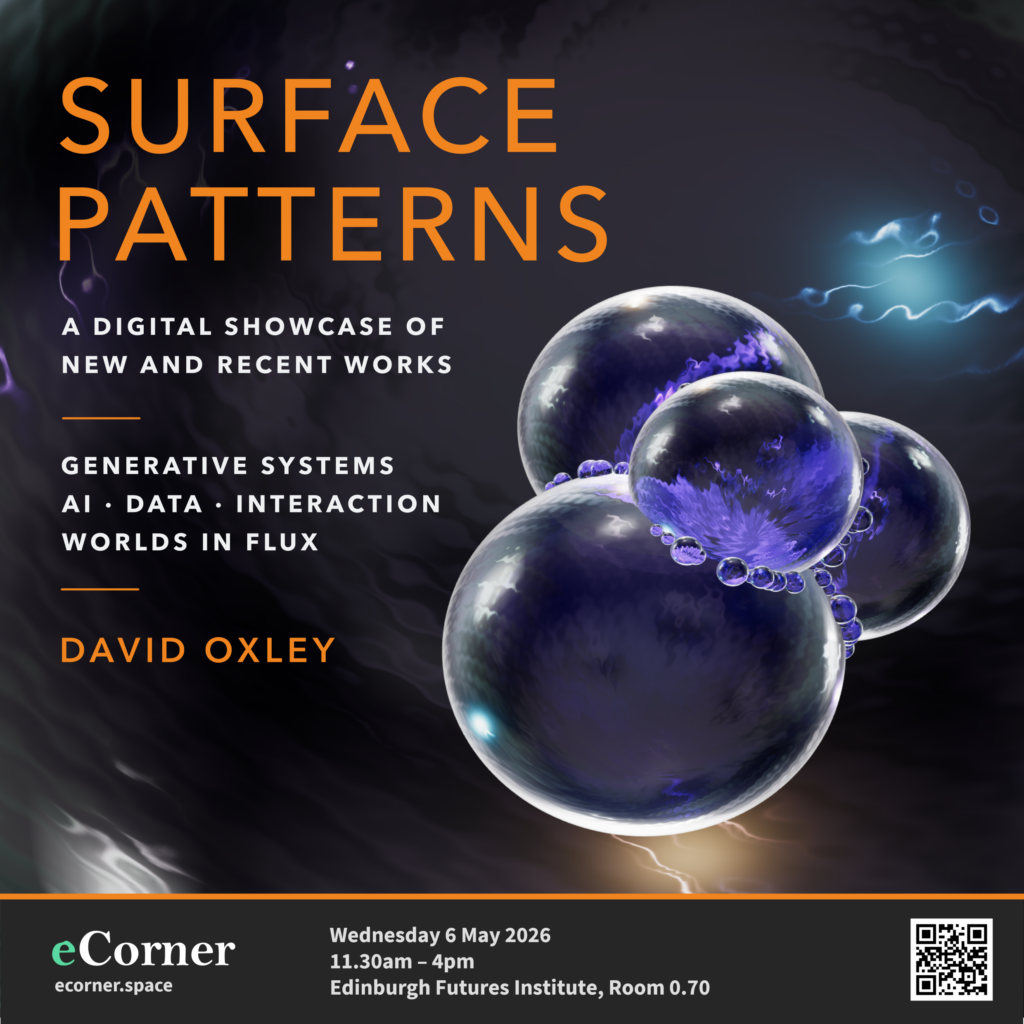
Surface Patterns at Edinburgh Futures Institute
The Surface Patterns exhibition at the Edinburgh Futures Institute had also been in discussion for a while, and took place in early May.
I was invited by eCorner to present a small exhibition of my work as a creative technologist and artist, bringing together algorithmic art, data-driven projects, interactive pieces and immersive experiences.
The show included Sphaerosymphony, which uses air quality data, along with works involving brain and body data, camera feeds, sensors, real-time image generation, audience interaction, and older algorithmic pieces. Some works were live systems, while others were fixed or time-based.
Several Raspberry Pi systems were set up to run continual showcase loops on the monitors at each of the conference stations within the room.
It was useful to see the work gathered together like that. When projects are made for different events, collaborations or technical experiments, they can start to feel quite separate. Surface Patterns gave me a chance to put them side by side and see how they sat together.
There were brainwave-driven visuals, interactive systems, mixed-reality games, algorithmic structures, real-time experiments and data-driven works. Some were polished pieces; others were more like live research objects. That mixture probably reflects my practice quite honestly.
The Chaos Engine
Around the same time, I returned to an older project from 2010 based on the Feigenbaum diagram.
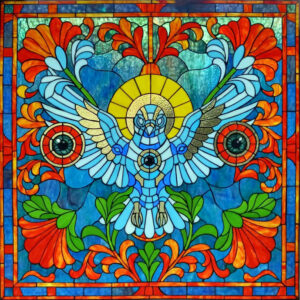
The new piece, The Chaos Engine, imagines the diagram as a mechanical system of brass and iron gears:
A butterfly rests on an ancient machine. Beneath it, brass and iron teeth wait in silence, arranged by the hidden arithmetic of chaos. One small movement releases the piston. Steam breathes, the wheels turn, and order begins to divide.
The original project was an attempt to turn the classic Feigenbaum diagram into a gear-like structure, even across the chaotic regions. Revisiting it now gave me the chance to bring that older algorithmic work into conversation with newer sound and data-driven elements.
The music for the piece was generated from 24 hours of air quality data recorded at my house.
I liked that connection. The visual side came from an older mathematical artwork, while the sound carried a trace of a real place and time.
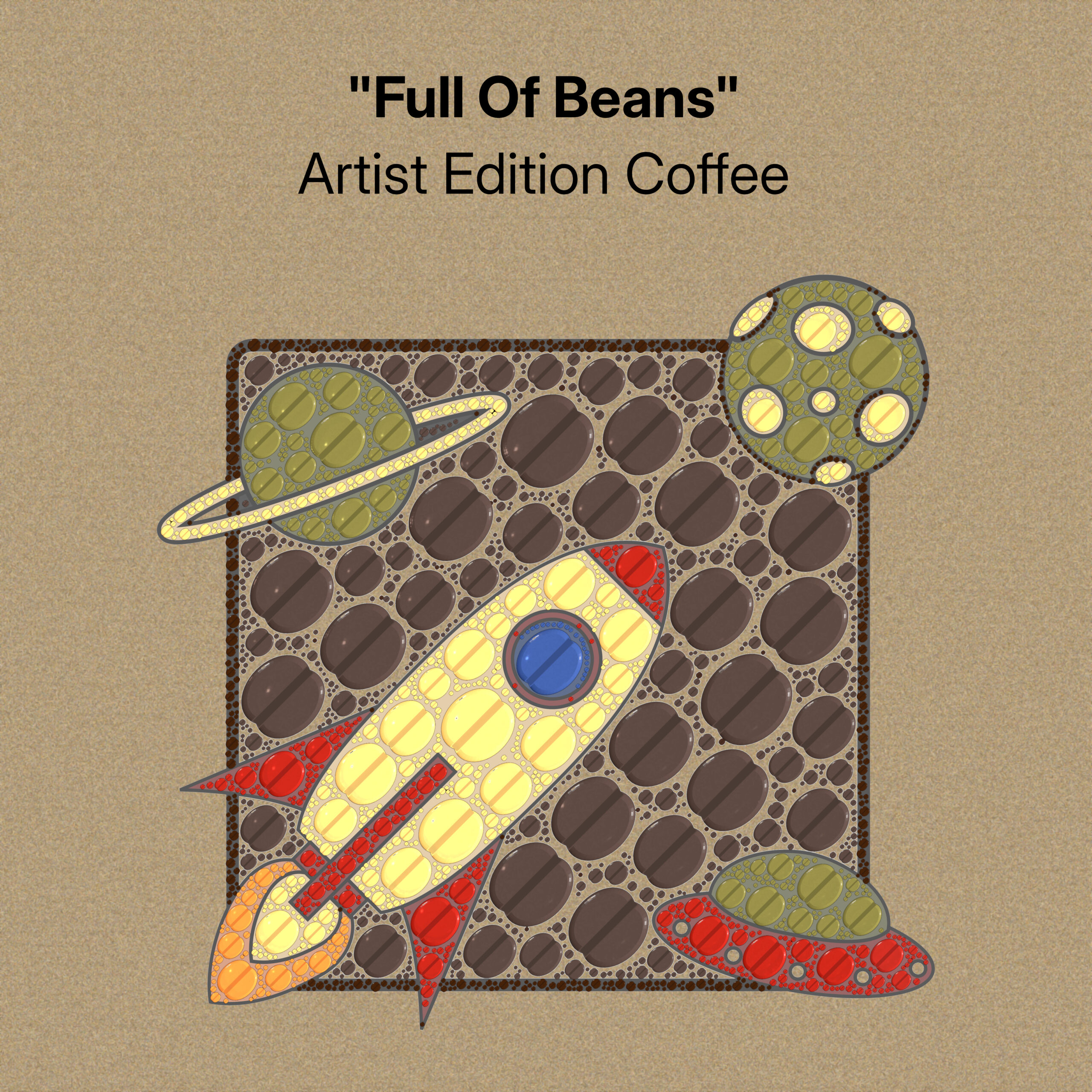
Full Of Beans
Not everything has involved headsets, sensors or code.
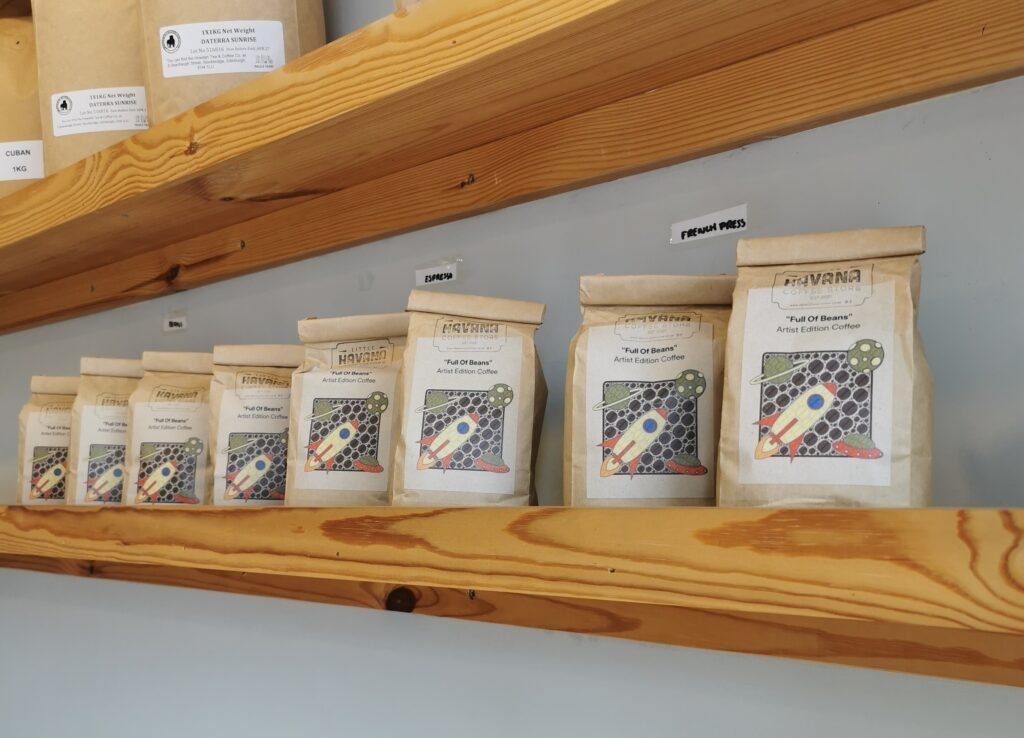
My Full Of Beans artist coffee blend is now available again at Little Havana Coffee Store on Leith Walk.
The blend was originally created for my Bridging Worlds exhibition back in January 2026, and it has been lovely to see it return as a small-batch collaboration.
It is simply very cool to have an art-coffee collaboration out in the world, and I’m grateful to Little Havana Coffee Store for making it happen.
Creative Tech Scotland, Trevor Jones and big screens behaving themselves
I helped support the setup for a large-screen showcase of Trevor’s work, with an added interactive element: people could walk up and start playing Dante’s Pixel Inferno, the game we worked on together.
The challenge was making it feel seamless. The system needed to play a high-quality showcase video, pause when someone wanted to play the game, switch into the game quickly, then time out and return to the showcase when nobody was playing. I configured a Raspberry Pi to run a version of the game with the showcase video embedded within the game code, and essentially running like a screensaver while also (and most importantly given the runtime of the showcase) resuming where it left off.
Later, at the Creative Tech Scotland afterparty with Venture Café, we also showed Titanium Angel with real-time capture of viewers into the painting, something we have explored before with Trevor’s work. This time instead of the powerful 5090 GPU laptop taking every step of the process, I set up a Raspberry Pi with an AI accelerator board to handle the person detection and segmentation before handing over the segmented frames to the ComfyUI API running SDXL Turbo on the laptop.
This is another part of my practice that I value: helping build interactive and technical systems around other artists’ work, especially when the technology needs to disappear enough for the artwork to take the focus.
Pint of Science: Air, GeoSounds
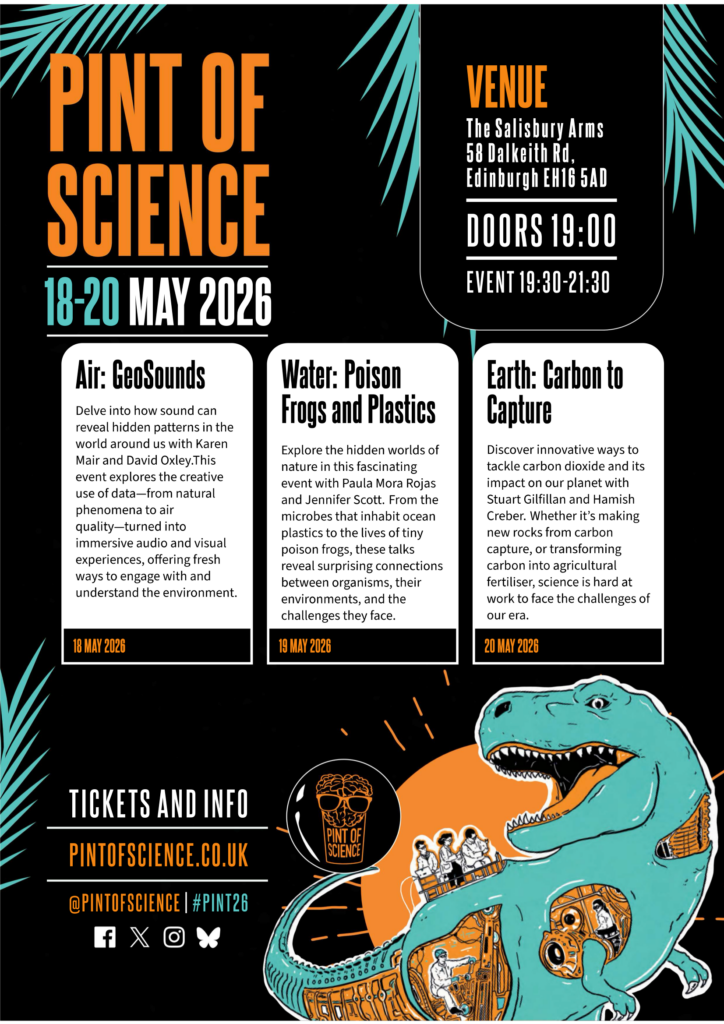
Most recently, on 18 May, I gave a talk at Pint of Science as part of the Air: GeoSounds event at The Salisbury Arms in Edinburgh.
The evening explored sonification: turning data or information into sound. Karen Mair opened with a fieldtrip through sound, sharing sonifications of natural phenomena including weather forecasts, river dynamics and geological processes.
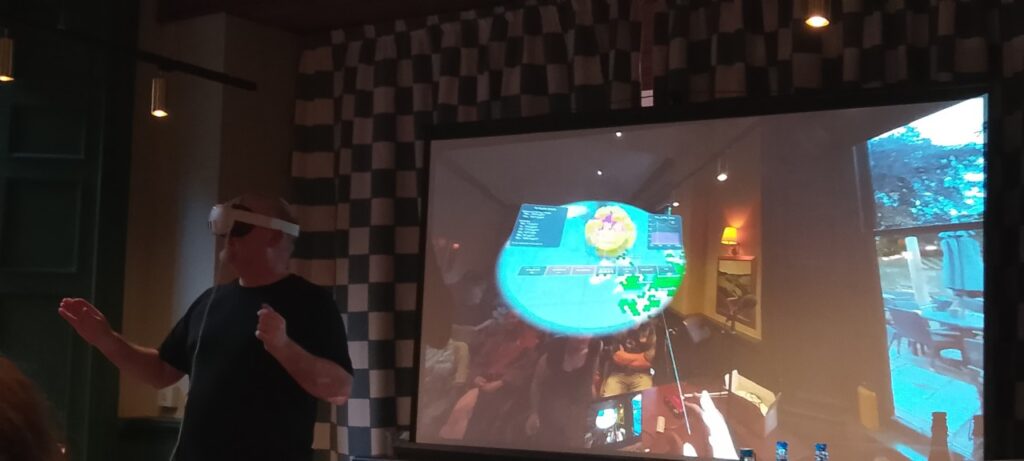
My talk returned to Sphaerosymphony, focusing on how measured air quality data can be transformed into evolving music and visuals.
Photo Credit: Donaldo Tho
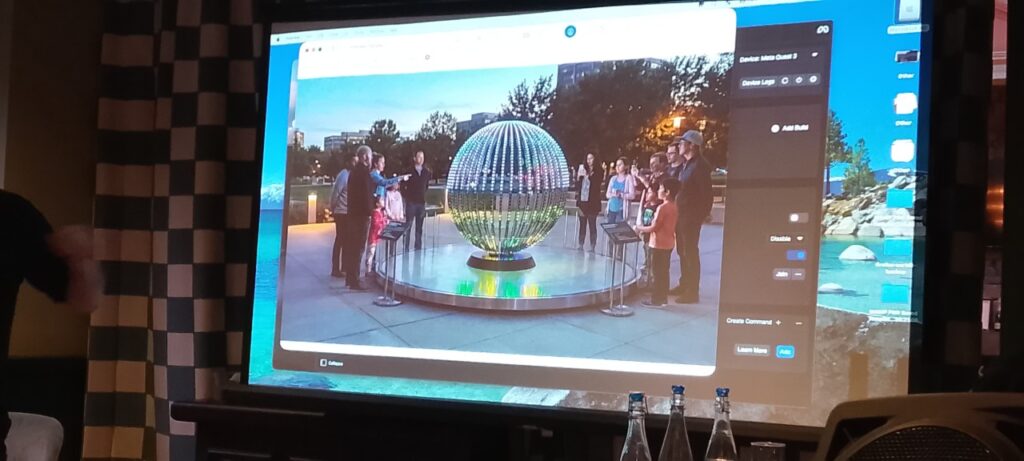
This talk also gave me a chance to look a little further ahead than previous Sphaerosymphony presentations. As well as explaining the current version of the work, I talked about where it could go next, including ideas for developing it into a more physical installation.
Photo Credit: Donaldo Tho
That feels like an important next step for the project. The VR and tablet versions have been useful for showing the concept and letting people explore different places and readings, but I am increasingly interested in how Sphaerosymphony could exist as a physical, spatial work with light, sound and presence in the room.
A busy stretch
It has been a lot to pack into a short period of time.
In the space of a few weeks I’ve shown Sphaerosymphony in several contexts, taken part in an Imagination Lab workshop, developed a mixed-reality drones game, presented a wider body of work at EFI, revisited an older algorithmic project, helped Trevor Jones with interactive event systems, given a Pint of Science talk, and had my Full Of Beans artist coffee blend on the shelves at Little Havana Coffee Store.
Alongside that, I’ve still been doing the web development work that keeps the lights on.
The creative technology work is the part I find especially enjoyable: building strange systems, making data audible or visible, connecting physical and digital spaces, and seeing how people respond when the work is placed in front of an audience.
There are already a few next steps forming, especially around Sphaerosymphony and future physical installations. For now, though, I’m glad to have had the chance to show so much work publicly, test ideas in different settings, and see where the conversations lead next.
Sphaerosymphony is an ongoing project where air quality data is turned into sound and evolving visual form. It’s not using simulated data or abstract inputs – it’s driven by real
At the recent HelloArt Lunar New Year Market at Out of the Blue Drill Hall, I presented a selection of prints, merch, and my coffee/art collaboration. Additionally, I had an
My first solo show, Bridging Worlds, just wrapped up at Whitespace Gallery in Edinburgh (3 – 8 January 2026). It was a real thrill to bring together pieces from different
My first “Data-Driven Theatre & Art with Raspberry Pi” workshop took place on Dec 5th 2025 at CodeBase Edinburgh, co-hosted with Clare Duffy from Civic Digits C.I.C. The session brought
From Saturday 3rd - Thursday 8th January 2026, Bridging Worlds brings together a constellation of generative, data-driven, and immersive artworks that sit at the intersection of the physical, digital, and imagined.
Building Trevor Jones’ Digital Revolution The core of EXPOS3D was always clear: surveillance, data capture, and participation under observation. The exhibition invited visitors into a space where technology not only
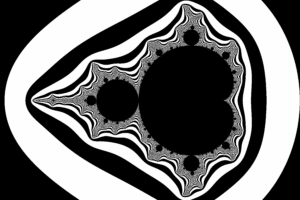
My fascination with patterns and chaos theory began in the early 1990s with a Commodore Amiga, AMOS Basic, and magazine cover disks that included tools like fractal generators. Inspired by
I’m excited to share that my exhibition, Perfectly Packed Pearls, is showing in Edinburgh from 11th July to 15th August 2025 at Society Cycles, Morningside. If you’re in Edinburgh, you
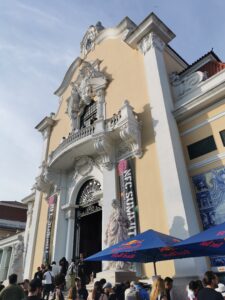
Just back from Non Fungible Conference Lisbon. I didn’t go to speak or show work – just to see what’s happening at the intersection of immersive digital art, AI, NFTs,
In this latest stage of my RAPTURE journey, I’ve taken a significant step forward – moving from cloud-based workflows to fully local, real-time rendering powered by an RTX 5090 GPU